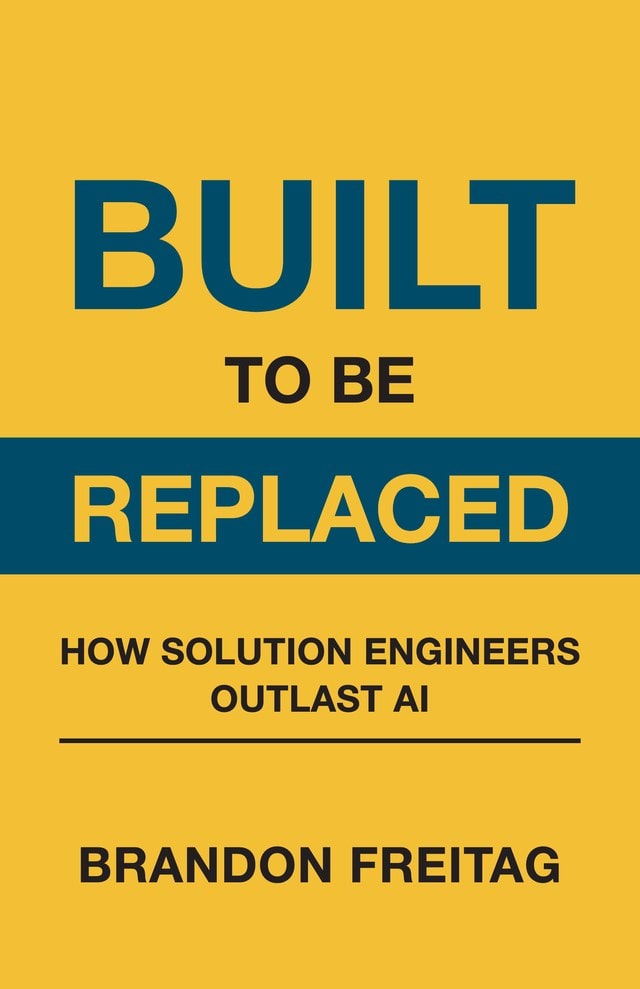
Coming January 2027
Built to Be Replaced
How Solution Engineers Outlast AI
The Trusted Advisor for the AI era, from both sides of the table.
The whole argument
One diagram, five moves.
The book makes one argument on one page: the system, the gap, the forcing function, the choice, and the asset.
Who it’s for
Five readers.
- The SE with scar tissue: who has watched quota attainment stay flat and customers fail with products they were sold rather than solutions they were ready for, and who is ready to stop taking the outcomes personally.
- The newer SE: early enough to feel the role’s pull toward pitches and activity metrics but not yet be shaped by it.
- The SE who already works this way: who tells customers hard things and has been told they are not commercial enough. For that reader this book is a vocabulary.
- The frontline SE manager: close enough to recognize every page and far enough in to feel the executive’s pressure land on their team first.
- The executive to persuade: the VP of Sales Engineering, the CRO, or the Chief Transformation Officer already asking whether AI changes the SE headcount model.
For the executive asking about SE headcount
AI can build a demo. SEs know what will work.
Your SEs know whether a solution will work for this customer, and that’s the difference between a deal and a renewal. The book shows how to build the role, and the organization around it, on that judgment instead of on demos produced.
From the introduction
The conversation already happening about you.
Somewhere in your organization, a conversation is happening that you are not part of.
It may be in a leadership offsite. It may be in a budget review. It may be in a one-on-one between your chief revenue officer and your CFO. The specific words vary, but the logic is consistent: the solution engineer (SE) role, as currently designed, is expensive, inconsistent, and increasingly approximated by AI. Demos, proof of concepts, technical objection handling, product knowledge are all increasingly automatable. The human is overhead. The AI is faster, always available, and doesn’t need a quota, a benefits package, or a manager.
If you have been in a pre-sales or solution engineering role for more than a few years, you have probably felt the edge of this conversation without being told it was happening. A headcount freeze framed as “doing more with less.” A new AI-assisted demo tool introduced as productivity improvement. A reorg that quietly reduced SE headcount while increasing coverage ratios. Leadership celebrating AI capability in the same meeting where they announced SE team changes.
This is not paranoia. The conversation is real. And for a significant portion of the SE population, the leadership having it has already decided the answer.
Here is what that conversation reveals, and what it does not.
It does not reveal that the SE role is without value. It reveals that in many organizations, the SE role has been built to be without value that AI cannot replicate. Those are different claims, one about what solution engineers are capable of, the other about what the organization chose to build.
You do not replace a trusted advisor with AI. You replace a tool with a better tool. When a sales leader says the SE is replaceable, he is not describing what the role could be, only what his organization has been building.
This book is written for the SEs who have spent years feeling the wrongness of that model without having a name for it.
Two Models
Because the rest of this book depends on the distinction, it is worth naming the two models plainly.
The tool model treats the SE as the technical arm of a sales motion: valued for product depth and demo fluency, measured on pipeline influenced, demos delivered, and proofs of concept (PoCs) completed. The seller who runs this model (in this book, the Path A seller) optimizes for the signature, because the signature is what the system measures, rewards, and celebrates. I will also call this the coin-operated model, for reasons Chapter 1 makes clear: put a quota in, get behavior out.
The partner model treats the SE as the deal’s primary diagnostic resource: the person whose job is to understand the customer’s actual problem, assess whether the organization can operationalize a solution, and say so honestly, before the contract is signed, even when saying so complicates the close. The seller who runs this model (the Path B seller) optimizes for the customer’s success, on the theory that success, not signatures, is what compounds into a career.
The tool model produces tool-replaceable people. Not because SEs aren’t capable of more, but because the system never asked for more, never measured more, and never rewarded more. That claim, and what AI does to it, is the argument of this book.
The launch crew
Help it land on launch day.
A book’s first days decide how far it travels. The launch crew is a small group of SEs, leaders, and colleagues who read three chapters early and post honest reviews on launch day, when a new book needs them most. Crew members get a direct line into how the launch unfolds.
-
Read the early chapters
The introduction, the opening chapter, and the chapter on AI arrive by email ahead of release, enough to judge the argument for yourself.
-
Review it on Amazon on launch day
The heart of the crew. Say what you think, and mention that you read the early chapters. Every honest review helps a new book get found.
-
Post about it on LinkedIn
The people who know your work are the readers this book is for.
Planning to buy a copy? It’s optional. Crew members get a note on the best time to pick it up.
Not up for a launch-day review? Just get notified when it’s out.
The field guide
The field guide ships with the book.
The field guide lives in the book’s appendix: the diagnostics, the self-checks, and the worksheets, ready to run against your own organization. Every copy carries the complete guide.
The free sampler is already here: the two-minute self-check runs the Five Breakpoints questions in your browser and gives you an honest first read right now.
Try the self-checkEssays and book news, by email
Essays for leaders on why change holds or doesn’t.
When it’s out
Just want to know when it ships?
Two emails: one when preorders open, one on launch day.
For press & podcasts
The media kit.
The kit collects everything a booker needs in one place: headshot, short and long bios, sample Q&A, and the one-page argument.